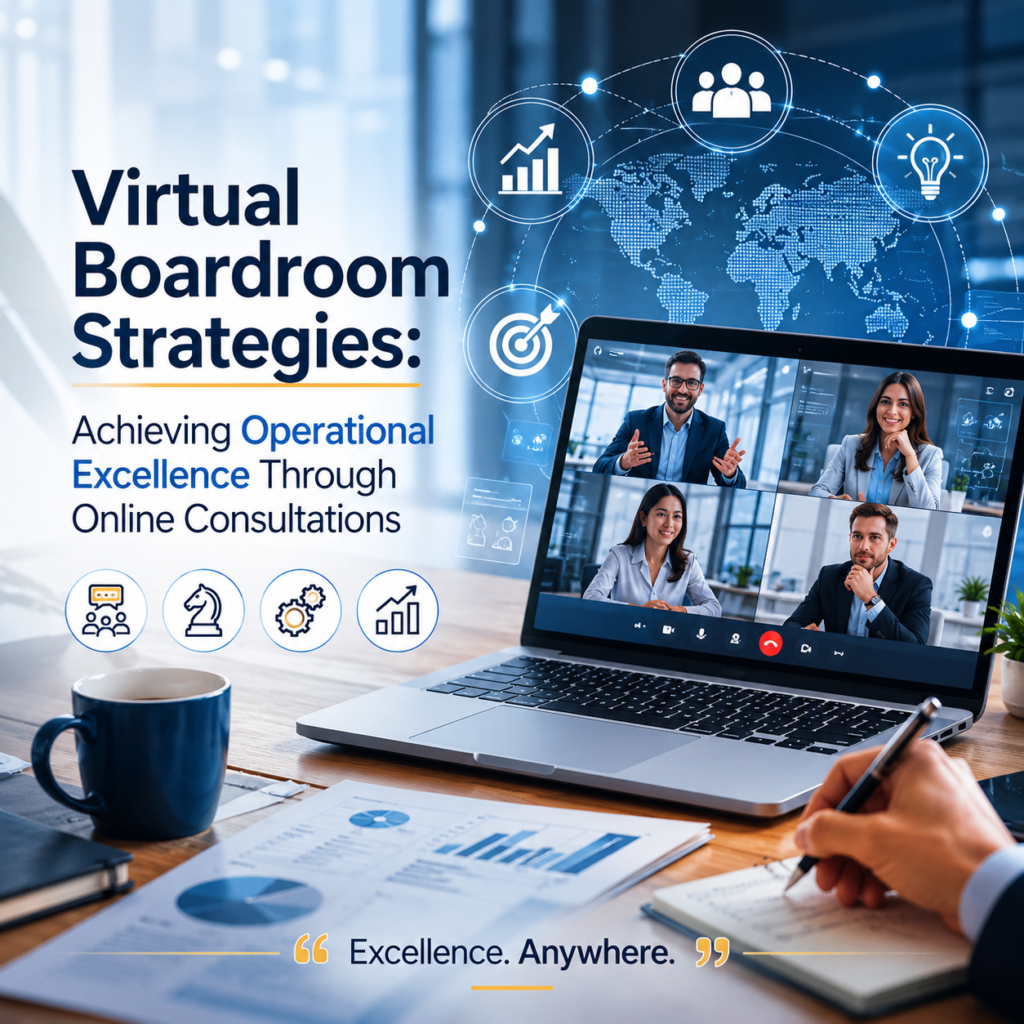
Virtual Boardroom Strategies: Achieving Operational Excellence Through Online Consultation
How can organizations achieve operational excellence through online consultation?
By using virtual boardrooms strategically to bring together leaders, consultants, and key stakeholders, organizations can make faster decisions, solve operational challenges, improve collaboration, and access specialized expertise without limitations of physical meetings. When supported by clear objectives, effective communication, reliable technology, and disciplined follow-up, online consultation can become a powerful tool for improving organizational performance.
The shift toward virtual business environments has changed the way organizations communicate, collaborate, and make decisions. What was once considered an alternative to face-to-face meetings has become an important part of modern management. Virtual boardrooms now allow organizations to connect decision-makers and experts across different locations, discuss complex issues in real time, and move from discussion to action more efficiently. However, simply holding meetings online does not guarantee better performance. Operational excellence requires more than technology. It requires a structured approach to consultation, decision-making, accountability, and continuous improvement.
What Is a Virtual Boardroom?
A virtual boardroom is an online environment where senior leaders, managers, consultants, and other stakeholders can meet, exchange information, evaluate challenges, and make decisions remotely. Unlike a traditional boardroom, a virtual boardroom is not limited by physical location. Participants can join from different offices, cities, or countries while accessing the same documents, reports, presentations, and performance information.
For organizations, this creates an opportunity to make consultation more accessible and responsive. A business facing an operational challenge, for example, does not necessarily need to wait until all relevant people can meet physically. The right experts can be brought together virtually, the issue can be analyzed, alternatives can be discussed, and decisions can be followed by clearly assigned actions.
The value of a virtual boardroom therefore lies not in the meeting platform itself, but in how effectively it is used to support organizational decisions and performance.
Why Online Consultation Matters for Operational Excellence?
- Operational excellence is about consistently improving the way an organization works. It involves efficient processes, effective resource utilization, informed decision-making, strong accountability, and the ability to respond to changing business conditions. Online consultation can support these objectives in several ways.
- Faster Access to Expertise
Organizations often need specialized knowledge to address operational, managerial, financial, human-resource, or strategic challenges. Virtual consultation makes it easier to bring the right expertise into the conversation without requiring consultants or specialists to be physically present. This can shorten the time between identifying a problem and developing a practical response.
- Better Decision-Making
Effective decisions depend on access to relevant information and diverse perspectives. A well-managed virtual boardroom can bring together people from different functions and areas of expertise, allowing leaders to examine an issue from multiple angles before deciding on a course of action. The key is to ensure that consultation remains focused. More opinions do not necessarily produce better decisions. The objective should be to create a structured discussion that leads to clear conclusions.
- Greater Flexibility
Modern organizations operate in environments where priorities can change quickly. Virtual consultation provides greater flexibility because meetings can be arranged without the logistical requirements associated with physical gatherings. This is particularly valuable when organizations operate across multiple locations or need to involve external consultants and experts.
- Continuous Improvement
Operational excellence is not achieved through a single strategic decision. It is built through continuous evaluation and improvement. Virtual consultation can provide a regular mechanism for reviewing performance, identifying obstacles, discussing lessons learned, and adjusting processes. Instead of waiting for an annual review or a major operational failure, organizations can establish a continuous dialogue around performance.
- Here Are Some of the Major Mistakes Organizations Make
While virtual consultation offers significant advantages, organizations can easily reduce its value by approaching it as nothing more than an online version of a traditional meeting.
- One common mistake is meeting without a clear purpose. If participants are not certain what the consultation is expected to achieve, discussions can become lengthy without producing meaningful outcomes.
- Another mistake is bringing too many people into every discussion. Effective consultation depends on having the right participants, not necessarily the largest number of participants. Each person should have a clear reason for being involved and, where appropriate, a defined role in the decision-making process.
- A third challenge is focusing too heavily on technology. A sophisticated virtual platform cannot compensate for poor preparation, unclear communication, or weak leadership. Technology should enable the consultation, not become the consultation.
- Organizations may also fail to document decisions and assign responsibility. A productive virtual meeting should end with clarity about what was decided, what needs to happen next, who is responsible, and when progress will be reviewed.
- Finally, some organizations treat online consultation as a one-time intervention. Operational excellence, however, requires continuity. Consultation should be connected to performance monitoring and follow-up rather than ending when the virtual meeting closes.
- Time to Learn a New Skill
Effective virtual consultation requires leaders and managers to develop skills that may be different from those traditionally used in face-to-face meetings.
- One of the most important is: virtual facilitation. Leading an online discussion requires the ability to maintain engagement, manage interruptions, encourage participation, and keep the conversation focused on its objectives.
- Digital communication is equally important. In a virtual environment, participants may have fewer opportunities to interpret body language and informal signals. Leaders therefore need to communicate expectations, questions, decisions, and feedback with greater clarity.
- Another essential capability is digital collaboration. Participants should know how to work with shared documents, dashboards, presentations, data, and other digital resources during consultation sessions.
- Leaders also need stronger listening and questioning skills. Online consultation should not become a one-way presentation from management or a consultant. The quality of the outcome depends on asking the right questions, challenging assumptions constructively, and ensuring that relevant perspectives are heard.
Perhaps most importantly, organizations need to develop the ability to turn virtual discussions into measurable action. A Consultation is valuable only when its insights contribute to better decisions, improved processes, or stronger performance.
- From Consultation to Action
The greatest challenge in any consultation, virtual or physical, is moving from discussion to implementation.
A practical virtual boardroom strategy should therefore follow a clear cycle:
- Identify → Consult → Decide → Implement → Measure → Improve.
First, the organization identifies the issue or opportunity that requires attention. The consultation then brings together the appropriate people and information to understand the situation. Once alternatives have been evaluated, decision-makers determine the preferred course of action. Responsibility is assigned, implementation begins, and results are measured against agreed indicators. The final stage is improvement. If the expected results are not achieved, the organization should ask why, learn from the experience, and adjust its approach.
This cycle transforms online consultation from a series of virtual meetings into a structured management practice.
- Failures Make Us Stronger
Not every decision will produce the expected result. In fact, organizations committed to improvement should expect some initiatives to require adjustment.
The important question is not whether a decision failed to produce the desired outcome, but what the organization learned from it. Virtual consultation can support this learning process by creating a regular space to review results openly. Leaders can examine what worked, what did not, which assumptions were incorrect, and what should change.
This requires an organizational culture in which mistakes are analyzed rather than simply blamed. When people are afraid to discuss problems, organizations lose valuable information. When challenges are examined constructively, they become opportunities for learning and improvement.
The virtual boardroom can therefore become more than a place for decision-making. It can become a platform for organizational learning.
- Building a More Effective Virtual Boardroom Strategy
To maximize the value of online consultation, organizations should establish a few basic principles.
- Start with a clear objective. Every consultation should have a defined purpose and expected outcome.
- Prepare participants in advance. Relevant reports, data, questions, and background information should be shared before the meeting whenever possible.
- Invite the right people. Participants should be selected according to their knowledge, authority, and relevance to the issue.
- Keep discussions structured. A clear agenda and effective facilitation help prevent meetings from becoming unfocused.
- Document decisions. Important conclusions, responsibilities, deadlines, and performance measures should be recorded.
- Follow up consistently. The effectiveness of consultation should ultimately be judged by what happens after the meeting.
- Measure results. Organizations should connect decisions to relevant performance indicators and use the results to guide future action.
When these principles are consistently applied, virtual consultation can become an integrated part of organizational management rather than simply a response to geographical or logistical limitations.
- Conclusion
Virtual boardrooms are changing the way organizations access expertise, collaborate, and make decisions. But the real advantage of online consultation does not come from technology alone. It comes from creating a disciplined environment where the right people can examine the right issues, make informed decisions, take responsibility, and continuously improve results.
Organizations seeking operational excellence should therefore look beyond the question of whether they can conduct meetings virtually. The more important question is whether their virtual consultations are creating better decisions and measurable improvements.
When online consultation is supported by strong leadership, clear processes, effective communication, and continuous follow-up, the virtual boardroom can become a valuable strategic tool—connecting expertise with action and helping organizations move toward greater efficiency, agility, and operational excellence.
- Frequently Asked Questions
- What is a virtual boardroom?
A virtual boardroom is an online environment where organizational leaders, managers, consultants, and other stakeholders meet remotely to discuss issues, review information, make decisions, and coordinate actions.
2.How can virtual consultation improve operational excellence?
Virtual consultation can improve operational excellence by providing faster access to expertise, supporting informed decision-making, improving collaboration, and creating opportunities for continuous performance review and process improvement.
3. Is virtual consultation as effective as face-to-face consultation?
Yes, It can be highly effective when properly structured. The outcome depends less on whether the meeting is virtual or physical and more on preparation, participant selection, facilitation, communication, decision-making, and follow-up.
- What are the biggest challenges of virtual boardrooms?
Common challenges include unclear objectives, ineffective facilitation, excessive participation, poor communication, technology problems, lack of engagement, and failure to follow up on decisions.
- What skills do managers need for effective virtual consultation?
Managers benefit from strong virtual facilitation, digital communication, active listening, questioning, collaboration, decision-making, and follow-up skills. They also need the ability to use digital tools effectively while keeping discussions focused on business outcomes.
- How can organizations make virtual meetings more productive?
Organizations can improve productivity by establishing clear objectives, preparing participants in advance, using focused agendas, involving the right stakeholders, documenting decisions, assigning responsibilities, and reviewing progress against measurable outcomes.
- Can virtual consultation support continuous improvement?
Yes. Regular online consultations can provide a structured opportunity to review performance, identify problems, learn from experience, and make adjustments. This makes virtual consultation a useful component of a continuous improvement approach.